andidates preparing for the STPI 2026 examination should regularly practice sample papers, previous year question papers, solved papers, and model papers to improve their preparation level. These papers help students understand the exam pattern, marking scheme, difficulty level, and important topics asked in the examination.
Solving previous year papers is one of the best strategies to increase speed, accuracy, and confidence before the exam. Many successful candidates recommend practicing mock tests and old papers daily for better results.
STPI 2026 Exam
The STPI (Software Technology Parks of India) recruitment and technical exams generally include questions from:
- Computer Fundamentals
- Operating Systems
- Computer Networks
- DBMS
- Programming Languages
- Data Structures
- Aptitude
- Reasoning
- Software Engineering
- Web Technologies
The exam usually contains objective-type multiple-choice questions (MCQs) with technical and aptitude sections.
Benefits of Solving STPI Previous Year Papers
Practicing previous year question papers provides several advantages:
- Understand the latest exam pattern
- Identify important and repeated questions
- Improve time management skills
- Increase problem-solving speed
- Boost confidence before examination
- Analyze weak and strong subjects
Students preparing for technical and government recruitment exams often use previous papers as part of their final revision strategy.
STPI 2026 Paper PDF Download
You can download STPI sample papers, solved papers, and model papers from educational portals and question paper repositories.
Download Question Paper
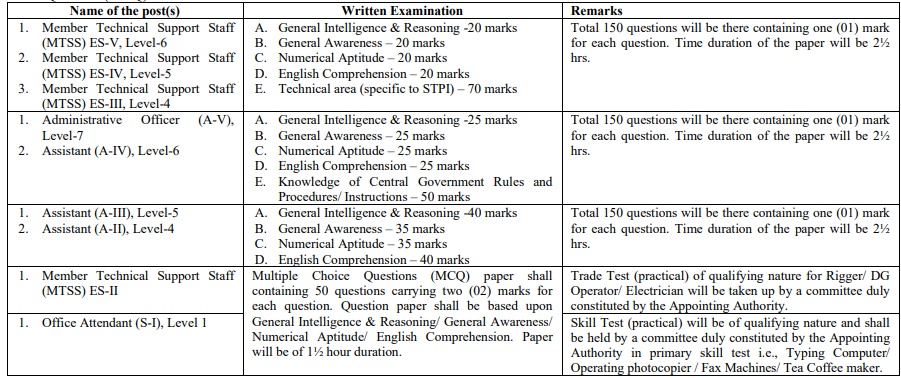
Important Topics for STPI 2026 Preparation
Technical Subjects
Focus more on these subjects:
- Operating Systems
- DBMS
- Computer Networks
- OOPs Concepts
- Software Engineering
- Web Technologies
- Data Structures & Algorithms
- C, C++, Java, Python Basics
(Syllabus for written examination (Technical Area)
Section 1: Digital Circuits
Number representations: binary, integer and floating-point- numbers. Combinatorial circuits: Boolean algebra, minimization of functions
using Boolean identities and Karnaugh map, logic gates and their static CMOS implementations, arithmetic circuits, code converters,
multiplexers, decoders. Sequential circuits: latches and flip-flops, counters, shift-registers, finite state machines, propagation delay, setup
and hold time, critical path delay. Data converters: sample and hold circuits, ADCs and DACs. Semiconductor memories: ROM, SRAM,
DRAM. Computer organization: Machine instructions and addressing modes, ALU, data-path and control unit, instruction pipelining.
Section 2: Computer Organization and Architecture
Machine instructions and addressing modes. ALU, data-path and control unit. Instruction pipelining, pipeline hazards. Memory hierarchy:
cache, main memory and secondary storage; I/O interface (interrupt and DMA mode).
Section 3: Programming and Data Structures
Programming in C. Recursion. Arrays, stacks, queues, linked lists, trees, binary search trees, binary heaps, graphs.
Section 4: Algorithms
Searching, sorting, hashing. Asymptotic worst case time and space complexity. Algorithm design techniques: greedy, dynamic
programming and divide-and-conquer. Graph traversals, minimum spanning trees, shortest paths
Section 5: Theory of Computation
Regular expressions and finite automata. Context-free grammars and push-down automata. Regular and contex-free languages, pumping
lemma. Turing machines and undecidability.
Section 6: Compiler Design
Lexical analysis, parsing, syntax-directed translation. Runtime environments. Intermediate code generation. Local optimisation, Data flow
analyses: constant propagation, liveness analysis, common subexpression elimination.
Section 7: Operating System
System calls, processes, threads, inter-process communication, concurrency and synchronization. Deadlock. CPU and I/O scheduling.
Memory management and virtual memory. File systems.
Section 8: Databases
ER-model. Relational model: relational algebra, tuple calculus, SQL. Integrity constraints, normal forms. File organization, indexing (e.g.,
B and B+ trees). Transactions and concurrency control.
Section 9: Computer Networks
Concept of layering: OSI and TCP/IP Protocol Stacks; Basics of packet, circuit and virtual circuit switching; Data link layer: framing, error
detection, Medium Access Control, Ethernet bridging; Routing protocols: shortest path, flooding, distance vector and link state routing;
Fragmentation and IP addressing, IPv4, CIDR notation, Basics of IP support protocols (ARP, DHCP, ICMP), Network Address Translation
(NAT); Transport layer: flow control and congestion control, UDP, TCP, sockets; Application layer protocols: DNS, SMTP, HTTP, FTP,
Email.
Section 10: Communications
Random processes: autocorrelation and power spectral density, properties of white noise, filtering of random signals through LTI systems.
Analog communications: amplitude modulation and demodulation, angle modulation and demodulation, spectra of AM and FM,
superheterodyne receivers. Information theory: entropy, mutual information and channel capacity theorem. Digital communications: PCM,
DPCM, digital modulation schemes (ASK, PSK, FSK, QAM), bandwidth, inter-symbol interference, MAP, ML detection, matched filter
receiver, SNR and BER. Fundamentals of error correction, Hamming codes, CRC.
Aptitude Topics
Important aptitude sections include:
- Percentage
- Profit and Loss
- Time and Work
- Number Series
- Simplification
- Probability
- Data Interpretation
Reasoning Topics
Prepare these reasoning topics regularly:
- Coding-Decoding
- Blood Relations
- Seating Arrangement
- Syllogism
- Logical Puzzles
- Direction Sense
Best Preparation Strategy
Follow these tips while solving STPI papers:
- Solve at least one paper daily.
- Practice papers in a timed environment.
- Revise technical concepts regularly.
- Analyze mistakes after every mock test.
- Focus on repeated questions from old papers.
- Prepare short notes for quick revision.
According to exam preparation communities, combining official sample papers with previous year papers is one of the most effective preparation methods.
Conclusion
STPI 2026 sample papers, previous year question papers, solved papers, and model papers are extremely helpful resources for exam preparation. Regular practice helps candidates improve speed, accuracy, and technical knowledge while building confidence for the final examination.
Candidates should download PDF papers, practice consistently, revise important concepts thoroughly, and attempt mock tests regularly to maximize their exam performance.